Thursday, April 18, 2013

7 Cub Scout Retention Tips

Dr. Geoffrey Zoeller, Patriots' Path Council vice president for membership and relations, observes that "one of the true strengths of the Scouting movement is our willingness to try new things, share ideas, and have frank conversations about what's working -- & what's not!!"

Today we share some of these great ideas in a post entitled "7 Cub Scout Retention Tips", which have been compiled by Mike Newman.  Like our own council's blog, Mike has been posting some very solid ideas on his site (which can be found at: http://kismif.org/cub-scout-retention-tips/).

Let's take a look at some of the wisdom Mike shares with us ...

#1 – Be Active.

boys-minds-book.jpg

There has been a lot of brain research to come out recently (as discussed in The Minds of Boys by Michael Gurian) confirming what many of us already knew about how boys are different than girls. Some of these findings are discussed in the November 2005 Scouting Magazine article: “The Minds of Boys“. In particular, boys’ brains tend to shut down if they are having to just sit passively for a long period of time and be talked at.

If you want boys to have fun or learn something, you need to make sure that what you are doing is an activity, preferably a fun one. If you just talk on and on while the boys are having to sit and listen, they will be bored silly and won’t want to come back.

Keep your den and pack meetings focused on activities rather than the boys having to just sit and listen. If you need to cover something instructional, turn it into a game, a quiz, a contest– something where the boys are actually involved and doing things.

And preferably it should be something that gets them out of their chairs. Get them physically moving around. Play active games. Look at stuff. Go outside. These are the kinds of things that boys enjoy.
The more activities that you do with your pack or den, the more your boys will be having fun and will want to come back each week.

Make sure that the time they have to just sit still passively is kept to an absolute minimum. Link

#2 – Field Trips.

police-visit-patch.jpg
Boys love field trips, and parents usually like them also. Boys like variety. Going somewhere new is almost always fun and exciting for them.

I would recommend that you try to have a field trip during your regular meeting time every month.
Some of our pack’s field trips include a senior center visit to sing Christmas carols, visiting our local library, and seeing a nearby nature center.

Of course, you should be sure to get a local tour permit and to send a thank you note afterward. Some of our pack’s field trips help with advancements (e.g., visiting a police station), but others are just good Cub Scout fun.

Field trips are probably the aspect of our program that our boys and parents enjoy the most.

#3 – Outdoor Focus.

nature-deficit-photo.jpg

Spending time outdoors doing stuff like hiking and camping are what boys are really looking forward to when they join Cub Scouts.

Make sure that hiking, camping, and other outdoor activities are a central part of your program. If your pack does not have regular Cub Scout hikes, I would encourage you to start.

A good article on this subject is “Let’s Hit the Trail” from the October 2007 Scouting. It discusses how regular hikes can create a lot of excitement for a Cub Scout pack. In my pack, hikes are a big hit with the boys and parents.

Of course, any outdoor Cub Scout activities need to be done in accordance with the Guide to Safe Scouting including the Age-Appropriate Guidelines for Scouting Activities.

Be sure that you promote in your pack Council-organized Cub Scout family camps and day camps. Boys who get to camp are the ones who are most excited about Cub Scouting.
Unfortunately, we live in a day and age when most kids are not getting to spend much time outside at all. Whether it’s due to playing video games and watching TV or concerns about possible child abductors, kids today are spending a lot less time outdoors than kids did a generation ago.

The May 2006 Scouting magazine article “Wonder of the Woods” has a very good discussion of this subject with Richard Louv, author of Last Child in the Woods: Saving Our Children From Nature-Deficit Disorder. Link

Doing outdoor hikes, games, and other activities with your Cub Scouts is not only what your boys would like to do, it’s also what’s good for them. (Photo: Scouting magazine.)

#4 – Stay in Touch.

cub-bumper.jpg

Communication with your pack families is very important.

For example, I think it’s a good idea whenever a boy is absent for your Cub meetings/activities, to give his parents a call. At the very least, you should call when the boy has missed two meetings in a row. Most parents are very appreciative that someone noticed their son wasn’t there and is checking to see how he is doing. Of course, you shouldn’t say “Why wasn’t Tommy here tonight?” You can say “We just wanted to let you know that we missed Tommy at our last activity. Is he doing okay?” In my experience, parents are usually glad that someone has called. Staying in touch like this is often enough to keep a boy who misses a few meetings from dropping out altogether.

Of course, sometimes boys have to miss for an extended period of time due to sports activities. When that happens, I always tell them that’s fine. We just ask that they stay in touch with us and with what we are doing, and we’ll welcome them back when their sports season is over.

For scouts who have just joined your pack, the first few weeks of Cub activities are very important. Even though they are officially members of your pack, most parents during the first few weeks are still making up their minds on whether this scouting stuff is worth their time and effort. They are still in an assessment stage. Help them make the choice to stay with your pack. Be sure your pack is welcoming to new families and that they are introduced to pack and den leadership. They may have lots of questions. You should answer their questions, but don’t overwhelm them with information. It is important to stay in contact with parents during the first few weeks so they will decide that this is something they want to continue to be a part of.

Email is very helpful with pack communication. Regular email reminders about upcoming events and activities can help ensure good attendance. I also recommend making and distributing periodic newsletters with upcoming events, contacts, and frequently asked questions (FAQ’s) as well as announcements of rank badges that have been earned.

Speaking of advancements, be sure your scouts are progressing as they should on their rank badges. If you see that someone is not coming along on their badge, touch base and see if there are any problems that can be addressed. Getting the rank badges earned and awarded is not only important for the boy’s sake, it also helps keep the boys and their parents wanting to come back.
Good communication can have a big impact on Cub Scout retention and keeping your pack running well.

#5 – Summer.

summertime-pack.jpg

Don’t stop your Cub Scout program for summer. Summer is when boys have the most free time on their hands, and it is when they need Cub Scouting the most.

“But won’t our boys and leaders be out of town on vacation during the summer?” Usually they will only be gone for a couple of weeks at most during the summer. Of course, you may need to pool your leadership resources on some weeks as some of your leaders are gone, but your pack boys and parents will be glad that your are still doing cool stuff during summer break.

Our pack started having an active summer program two summers ago, and it has worked out great for us. It has helped us with Cub retention over the summer and has been a big boost for May recruiting.
It is a lot easier to keep your scouts coming to your scouting program in the fall if you haven’t stopped for a three-month break. Cub Scouts are much more likely to drop out in the fall if they haven’t done any Cub Scout activities all summer.

Having an active summer can help with May recruiting as a lot of parents in May are looking for something for their kids to do during the summer. Cub Scouts is a great thing for boys to be doing during the summer.

summertime-pin.jpg

Having an active summer program can qualify your boys to earn the National Summertime Pack Award (Link) and can help them earn the Cub Scout Outdoor Activity Award (Link).

 csoa-award.jpg
This link is to a good article from the May 2002 Scouting magazine on the benefits of having an active summer program. Link

Cub Scouting in the summer is great. If your pack doesn’t have a summer program, now is the time to start.

#6 – Schedule.
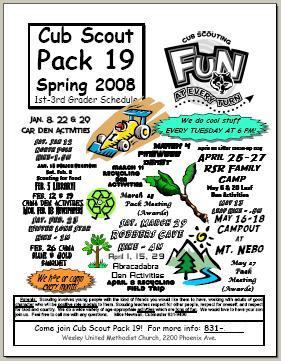
p19-spring08-sched-thum3.jpg

Making and distributing a schedule several months in advance can be a boost for your pack in several ways.

For one thing, it will make your pack look fun and exciting. Just telling your scouts and parents that your pack does hiking, camping, outdoor games, Pinewood Derby, etc. is fine, but it is more convincing if you can hand out a schedule that shows that you have committed your plans to paper.
A schedule will also help with new scout recruiting. Your schedule will show new recruits that your pack is well-run, organized, and lots of fun. It will help convince boys and their families that your Cub Scout program is where they want to be. Making a schedule will also help ensure that your pack follows through and does the Cub Scouting things your boys would like to do.

The best way to be sure your pack does things like hiking and camping is to set a date, make a schedule, and get it distributed. If you don’t make a schedule, it is easier for your pack to let the time slip by and not do the stuff you hoped you would.

In our pack, we hand out a 1st-3rd grader schedule (Link) and a Webelos schedule (Link) every few months to let our scouts and families know what events and activities are coming up with our pack. We use the same (or similar) flyers for our recruiting. Our schedules have helped our pack a great deal with recruiting new boys and with retaining our current members.

The important thing is to plan cool Cub Scouting stuff and distribute your schedule so current scouts and potential recruits will know about the awesome stuff boys in your pack get to do.

#7 – Webelos Appeal.

webelos-slide.jpg

Although the boys in your pack are all kids, they are not all young kids. They probably range from 6 to 11 years old.

There is a lot of difference between 6 and 7 year olds and 10 and 11 year olds. Some activities that are a lot of fun for your Tiger and Wolf dens would be way too young and kiddie-ish for most Webelos Scouts.

It’s not a great idea to have your entire pack doing an activity that will make your Webelos Scouts feel like they are back in nursery school. For example, singing “I’m a Little Teapot” can be a lot of fun for your Tigers, but if you make your Webelos join in many songs like that, they may just look at each other and say “We’re too old for this.” and not come back.

One of the great things about putting on a Cub Scout program is seeing how much boys grow and develop from the time they are first grade Tigers until they are fifth-grade Webelos. Be sure most of your pack activities are designed for the interests and needs of all your boys.

Thursday, April 4, 2013

Kickball Tournament & Marshmallow Roast to Recruit/Engage Kindergarten Families


Patriots' Path Council vice president of membership/relations, Dr. Geoffrey Zoeller, notes that "next year's Tigers and Tiger Leaders are in our schools right now -- they are our Kindergarteners.  We need to make every effort to meaningfully engage families during the Kindergarten year.  Strategies for making connections with Kindergartners are crucial.  Also be sure to keep an eye out for which of their parents/guardians might make good adult leaders."

One great idea is to hold a Kickball Tournament and Marshmallow Roast.  It can be for just Kindergarteners, a combined event with your current Tiger Den, it can be a school-wide activity -- you decide what works best for you.

Learning kickball skills and chatting up Kindergarten parents can strengthen your unit!


The Kickball Belt Loop makes for a great hook.  Tigers can earn the belt loop and Kindergarteners wish they were already Scouts so they could get it too!

Be sure to award it then and there.  It is also an effective means of introducing prospective Scouting families to one aspect of the Cub Scouting awards program.

This belt loop is quite age-appropriate for Tigers and Kindergarteners, and the basic skills to earn the award are easily introduced, practiced, and mastered.

The three requirements are easy to achieve as part of the overall activity:
  1. Explain the rules of kickball to your leader or adult partner.
  2. Spend 30 minutes practicing the skills of kickball (pitching, kicking, base running, catching, throwing). This may be over two different practice periods.
  3. Play a game of kickball.
What great den meeting doesn't end with a tasty snack?  In this case, a Marshmallow Roast over an open fire can help get Kindergarten boys excited and allows them to see one of many activities they will be able to participate in if they start going on camping/outdoor activities with the pack.  A table with graham crackers and chocolate will allow families to make yummy s'mores (see: http://en.wikipedia.org/wiki/S'more and http://allrecipes.com/recipe/smores/).

A small controlled fire is the best and will put parents at ease.
Long, thin dowels from Home Depot or Lowes make great roasting sticks.
Note the safety circle drawn on the ground and have safety equipment close by.

Be creative, but keep it fun.  Baden-Powell said it best when he spoke of "fun with a purpose".  Earning a belt loop, having fun, eating s'mores, and recruiting new families and leaders -- now that's a purpose we can all agree on!

For some other kickball resources, go to:
http://www.scouting.org/scoutsource/CubScouts/CubScouts/UniformsAndAwards/sanda/kickball.aspx
http://www.kickball.com/
http://www.boyscouttrail.com/external_frame.asp?goto=/cub-scouts/acadsports/kickball.pdf
http://scoutermom.com/1000/kickball-belt-loop/

Friday, March 22, 2013

Kindergarten Engagement/Recruitment - Stomp Rockets

Dr. Geoffrey Zoeller, Patriots' Path Council vice president of membership/relations, makes the observation that "we already know who next year's Tigers and Tiger Leaders are -- they are your current Kindergarten class.  Too often we forget that and miss the opportunity to meaningfully engage families in what Scouting is all about before we try to recruit them to join.  We need to develop strategies for making connections with Kindergartners now and at the same time keeping an eye out for which of their parents/guardians might make good adult leaders."

One great idea is to hold a Stomp Rocket Derby.  It can be for just Kindergarteners, a combined event with your current Tiger Den, it can be a school-wide activity -- you decide what works best for you.

 
This launcher design produces no waste, and should cost around $10.

Multiple launchers will allow for a competitive event.

A Stomp Rocket Derby can include making the rockets from scratch, having teams develop a team rocket, and a whole host of competitive (and FUN!!) activities.  Both the launcher and rockets are easy to make:
 
 
 For one launcher, you will need:
  • One 10-foot length of 1/2-inch PVC
  • One 1/2" 90-degree elbow (all fittings are of the slip variety)
  • One 1/2" four-way fitting
  • Two 1/2" end caps
  • One 1" coupling
  • One 1" by 1/2" bushing
  • One 2-liter soda bottle cap
  • Lots of 2-liter soda bottles
Other supplies you will need for this project:
  • PVC cement
  • Hot glue
  • White glue
  • Cotton balls
  • Tape
  • Sheets of 8 1/2" by 11" paper
  • Lots of copies of the rocket template (see second web-link below)

It should be noted that this concept is not a new one.  You can find resources on how others have done this at:

http://www.scouting.org/scoutsource/Membership/Youth_Recruitment/Events/Rocket.aspx

http://www.instructables.com/id/Paper-Stomp-Rockets-Easy-and-Fun/

http://www2.scouter.com/forum/open-discussion-program/7246-rocket-launch-as-a-recruiting-night-draw

http://www.google.com/search?sourceid=navclient&aq=&oq=scouting+rocketry&ie=UTF-8&rlz=1T4WQIA_enUS521US522&q=scouting+rocketry&gs_l=hp..0.0l4.0.0.0.10671...........0.&pbx=1#hl=en&rlz=1T4WQIA_enUS521US522&sclient=psy-ab&q=scouting+rocket+derby&oq=scouting+rocket&gs_l=serp.1.0.0i22i30l4.9155.9308.0.12759.2.2.0.0.0.1.166.328.0j2.2.0...0.0...1c.1.7.psy-ab.dYeUX60kF4M&pbx=1&fp=1&biw=1600&bih=744&bav=on.2,or.r_qf.&cad=b&sei=wTlLUfv-M-LB4AOX-4HQBg.

Thursday, March 14, 2013

Use Adopt-a-School to assist with School Access Issues

Dr. Geoffrey Zoeller of Patriots' Path Council discusses the Adopt-a-School Program.   "This relatively new program, launched by the BSA, seeks to connect Scout packs, troops, and crews across the country with schools in their communities."  Participating Scouts then work, within clearly defined guidelines, to partner with school administrations and offer the volunteer services that most efficiently meet their school’s needs. With each unit offering their school a minimum one-year commitment, meaningful community relationships are built and significant changes will happen in the schools.

The hope at the heart of Adopt-a-School is to build strong, sustaining relationships with these schools… creating thousands of lasting community partnerships across the U.S.  Through committed volunteer efforts – from landscaping and clean-up outside the school building to Scouts’ active participation in school events throughout the year – the BSA will become a defined presence in improving our nation’s schools.

To learn more about the Adopt-a-School program, watch this video:  http://www.youtube.com/watch?feature=player_embedded&v=3kLV2j_1WYc

Or visit the Adopt-a-School Program website at: http://www.bsaadoptaschool.org/

Thursday, March 7, 2013

New Venturing Recruitment Toolkit

Patriots' Path Council's vice president for membership and relations, Dr. Geoffrey Zoeller, discusses the new Venturing Recruitment Toolkit.  "The BSA has put out some great, new resources to help support councils, districts, and individual crews with strengthening Venturing programs to young people in their area."

Recruitment is a process that should be reevaluated each year as the crew learns and develops.  It's just as important to retain existing crew members as it is to grow the crew.  Use BSA's tools to assist with recruiting more teens to your crew or reconnect with former members who have become inactive or lost interest.  Encourage and invite them to reconnect with and engage in the crew.  Sometimes all it takes is that personal outreach or invitation to draw them in.

Visit the BSA site to download Toolkit at:  http://www.scouting.org/scoutsource/Membership/Youth_Recruitment.aspx

Monday, March 4, 2013

Scouts with With ADD, ADD/ADHD, and Special Needs

Scouting should be accessible to all youth and the Patriots' Path Council has been working hard to provide training and resources to support Scout leaders that work with young people with special needs.

Dr. Geoffrey Zoeller, PPC vice president of membership and relations, points out that this month's ScoutCast has a great video segment on "How to Handle Boys in the Troop With ADD, ADD/ADHD, and Special Needs".

Attention deficit-hyperactivity disorder.  What is it?  How do you know if someone in your troop has it and, more important, how do you as a leader handle a boy who has this disorder or other special needs?  Joining us for this delicate yet important discussion is Tony Mei, a 40-year Scout volunteer with the Marin Council in San Rafael, California.  He’s been working with Scouts with disabilities for almost 15 of those years and has developed training for College of Commissioner Science classes for Scouting with special needs and disabilities, including ADHD and autism spectrum.
 
Go to:  http://www.scouting.org/scoutcast.aspx  to see the March 2013 ScoutCast on this very important topic.

Friday, March 1, 2013

Strengthen Relationships with Important Community Members

Dr. Geoffrey Zoeller, PPC vice president for membership and relations, shares a valuable membership tip on strengthening relationships.  "Having a great working relationship with important community members, particularly school officials, is critical when it comes to recruitment and retention.  Access to boys, families, facilities, and resources all has a lot to do with who you know and what kind of relationship you have with them.  That's why it is critical that you recognize individuals for their efforts and support."

Just as your scouts love to get patches and awards for their accomplishments, we need to make sure we are doing the exact same thing for those community members that support our units.  Certificates of Appreciation are on sale at your local scout shop for a very reasonable price.  Your chartered organization and your school principal are obvious choices -- and they will appreciate the positive PR too!  Why not take a few minutes to help strengthen relationships with those that help you the most? 


Cub Scout Pack 165 cubmaster, Dr. Geoffrey Zoeller, presents Katherine D. Malone Elementary School principal, Mr. Michael Valle, with a Certificate of Appreciation from the Boy Scouts of America for his outstanding support of the Scouting movement and of Cub Scouting in his school. Thank you Mr. Valle!